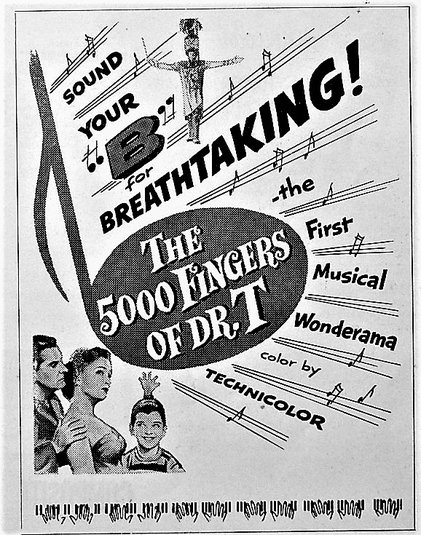
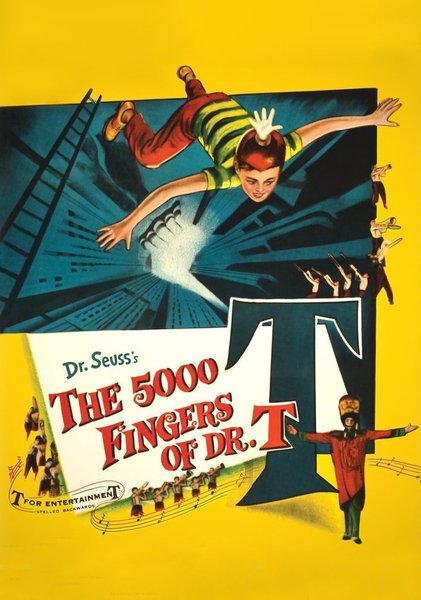
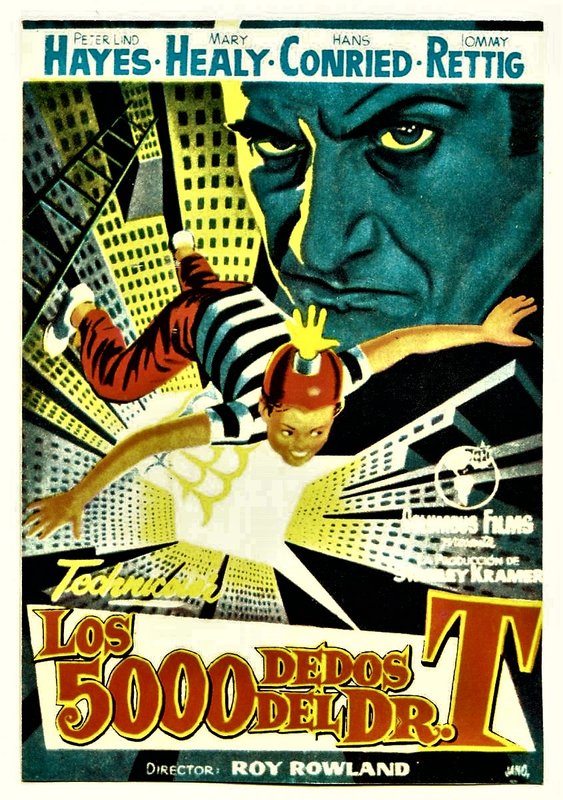
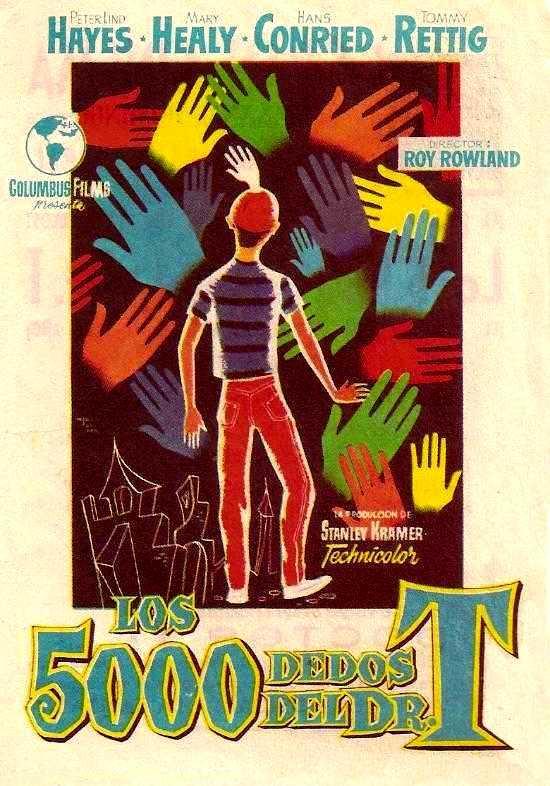
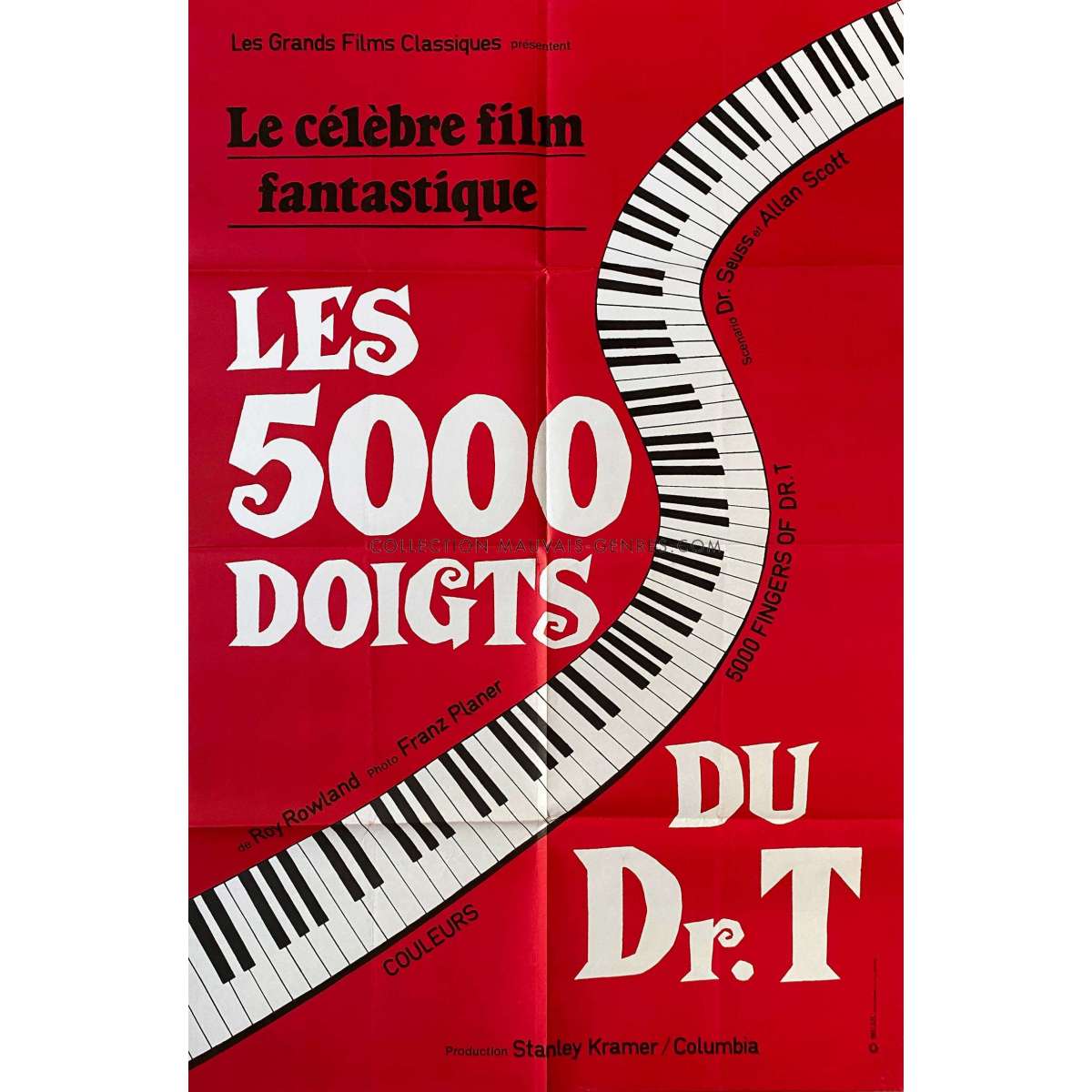
The 5000 Fingers of Dr. T

"T" for entertainmen"T" (spelled backwards)

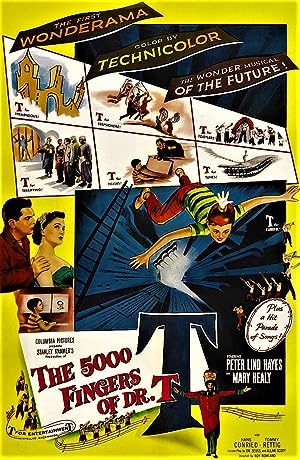
Buckle your seatbelts! This is a weird one. The 5000 Fingers of Dr. T is a 1953 movie musical writen by Theodor Seuss Geisel, better known as Dr. Seuss. It's also the colossal flop that made him scared to return to the film industry for decades.

There is no downfall for a piece of media quite like "this has colorful and creative visuals so everyone assumes it's made for kids and then critisizes it for being too dark/intellectual."

There is so much to love about this movie. The classic dream sequence of a kid who falls asleep during piano lessons and dreams of his teacher as a facist dictator forcing all little boys to learn piano. The 50's golden age score. The absurd dialogue. And of course the visuals, the visuals, the VISUALS!!!

Thank the gods for the internet archive, you can watch it right now! I wouldn't be too concerend about spoilers though, the story is pretty simple.

I'm also almost positive this movie inspired that one Goosebumps book/episode.

While not credited as a designer, the designs of the show are so very Suessian, and are reminicent of his Midnight Paintings more than anything else. Stunningly rendered in 3-dimensions as the charcters crawl all over surreal Escher landscapes, some covered in shag carpeting. This is the most dream-like I have ever seen a movie set, especially with how everything stretches far above their heads and staircases are just stlightly too tall to comfortably climb.

The script went through many revisions. After an early test-screening, 11 of the 24 songs written for the movie were cut. Many of these songs still survive in archive recordings, and this pre-cut script can be found floating around online. Unsurprisingly, the version of the movie before all these cuts was much more cohesive, plot-wise and thematically. Some of my favortie cut songs include "Money" "Grindstone" and "I Will Not Get Involved", as well as the last verse of the Dungeon Song. While some audio persists, and multiple scripts archived, the scrapped footage is lost.

Song List

Original "preview" version:

  • 1. Overture / Opening Credits
  • 2. Ten Happy Fingers
  • 3. Piano Concerto (Ten Happy Fingers variation)
  • 4. Oh! We Are the Guards
  • 5. Many Questions
  • 6. My Favorite Note
  • 7. Dungeon Ballet
  • 8. Grindstone
  • 9. I Will Not Get Involved
  • 10. Dream Stuff
  • 11. I Won't Go to Bed/Massage Opera
  • 12. You Opened My Eyes
  • 13. Hypnotic Duel
  • 14. Because We're Kids
  • 15. Money
  • 16. Freckle on a Pygmy
  • 17. Butterfly Ballet
  • 18. We Are Victorious
  • 19. Dressing Song / Do-Mi-Do Duds
  • 20. End Credits
Theatrical cut:
  • Opening Credits / Butterfly Ballet — Dream Sequence
  • Ten Happy Fingers
  • Piano Concerto (Ten Happy Fingers variation)
  • Dream Stuff
  • Hypnotic Duel
  • Get Together Weather
  • Because We're Kids
  • Dungeon Ballet
  • We Are Victorious
  • Dressing Song / Do-Mi-Do Duds
  • End Credits
Releases

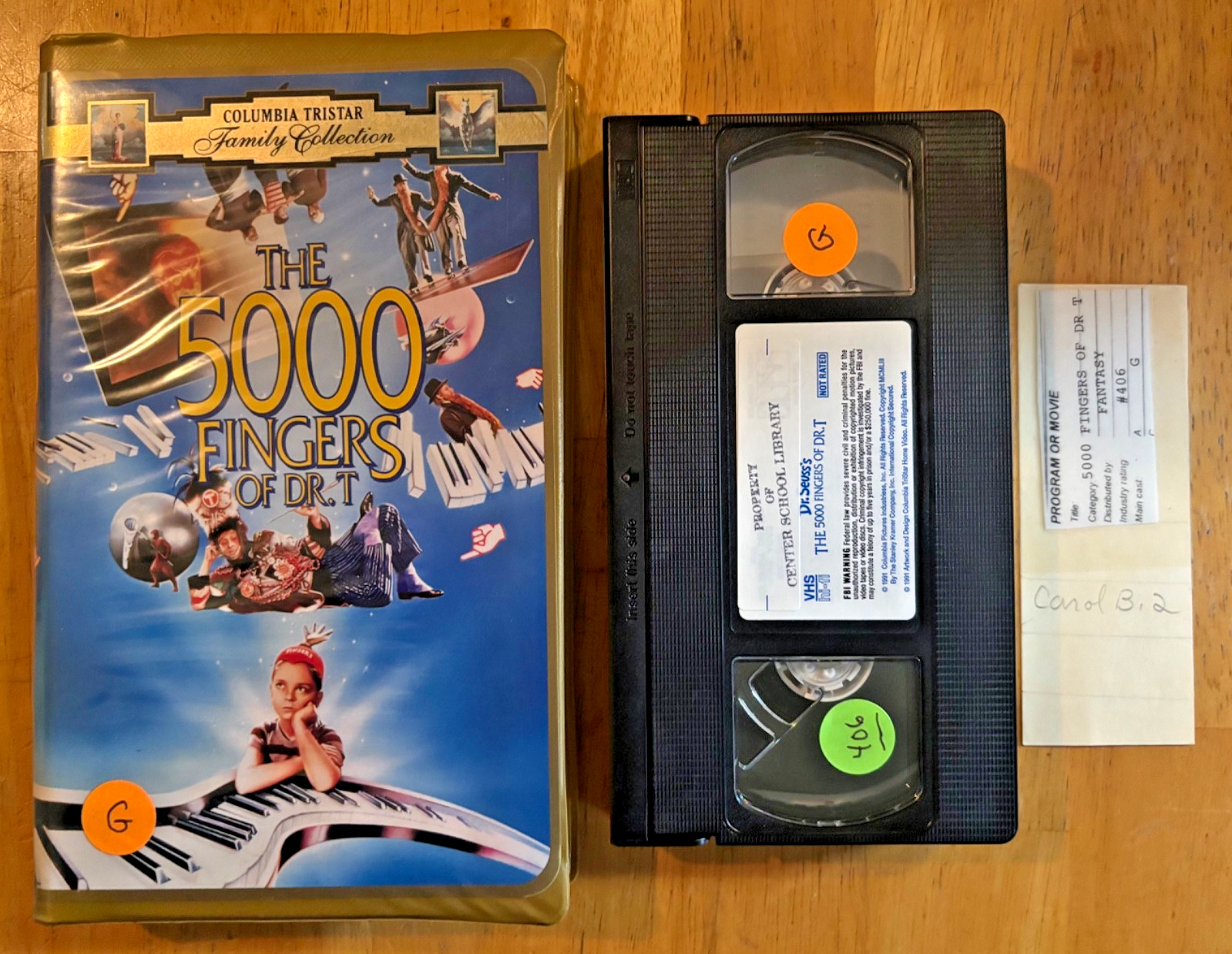
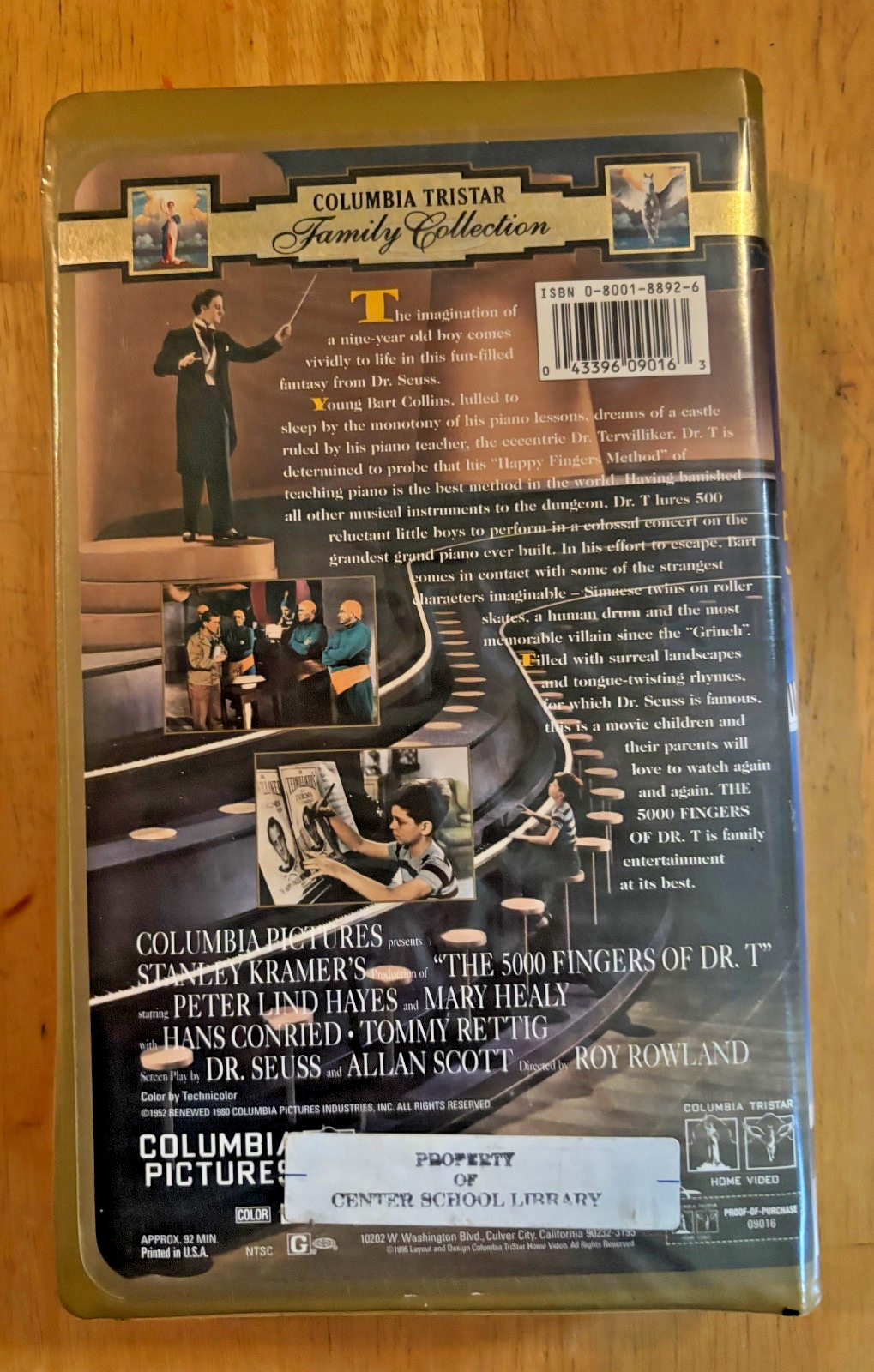
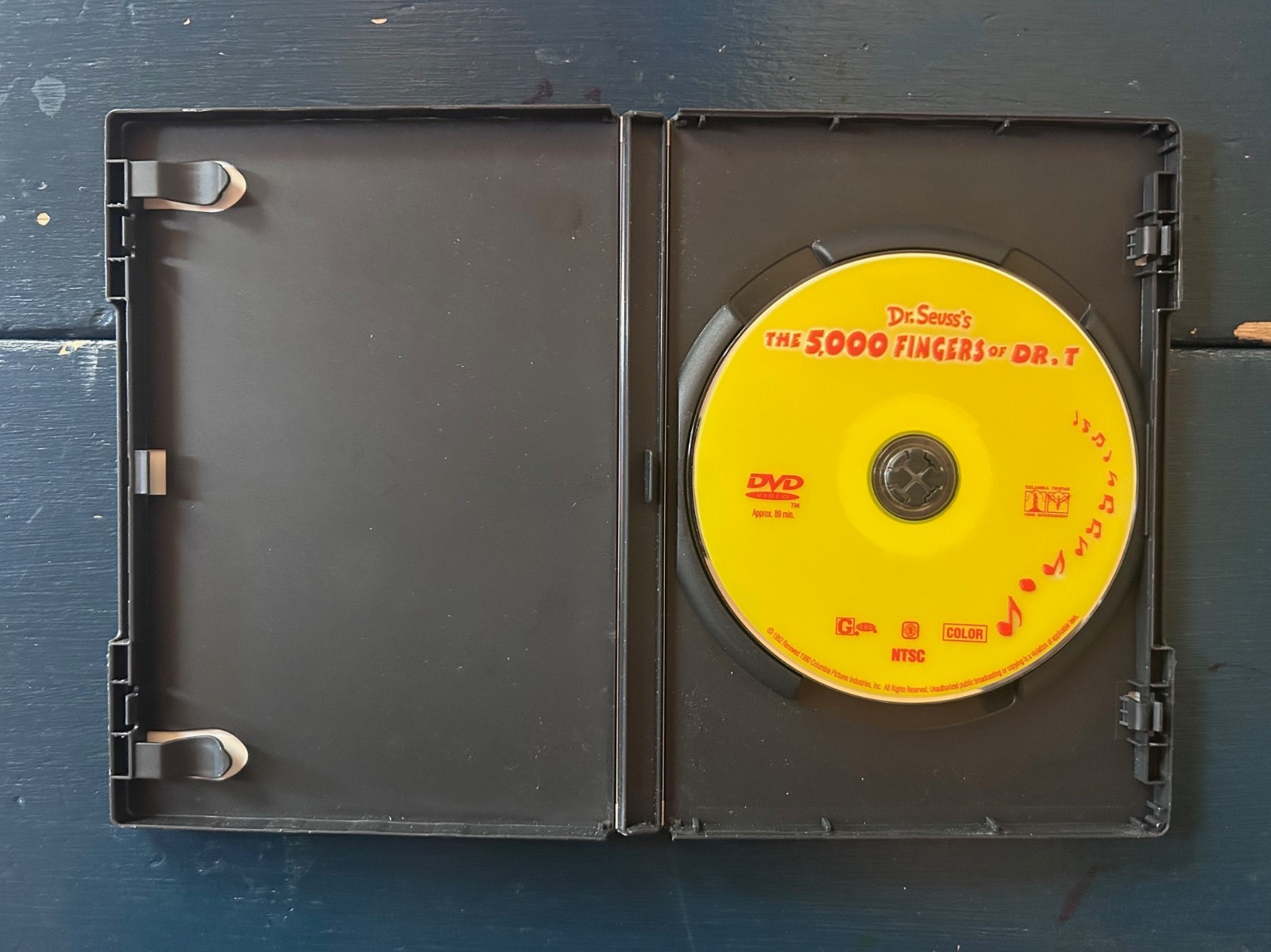
Since the film is from the 50's there was no original home movie release. The first releases came in the 90's on VHS, in addition to a Laserdisc in 1991!

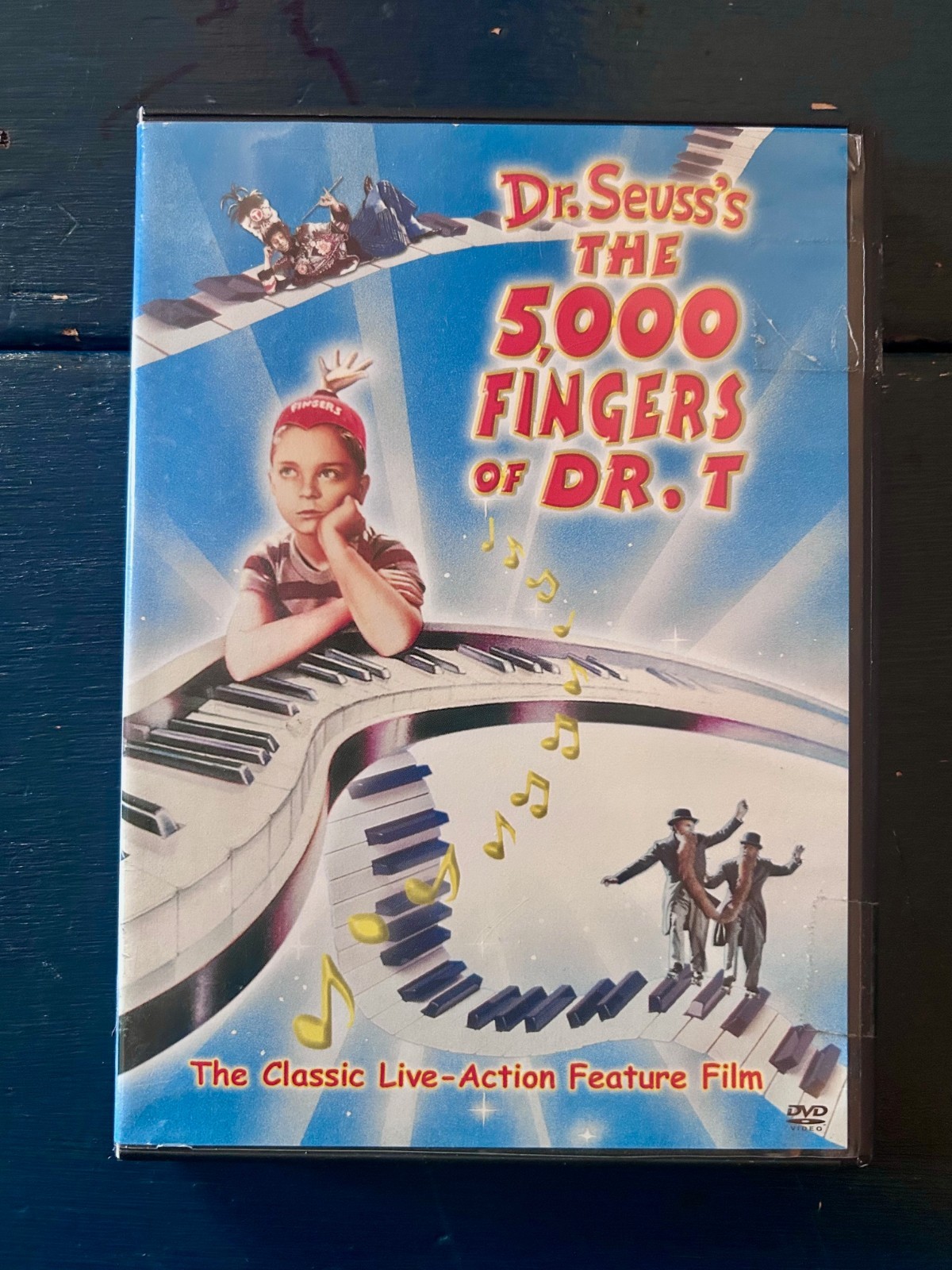
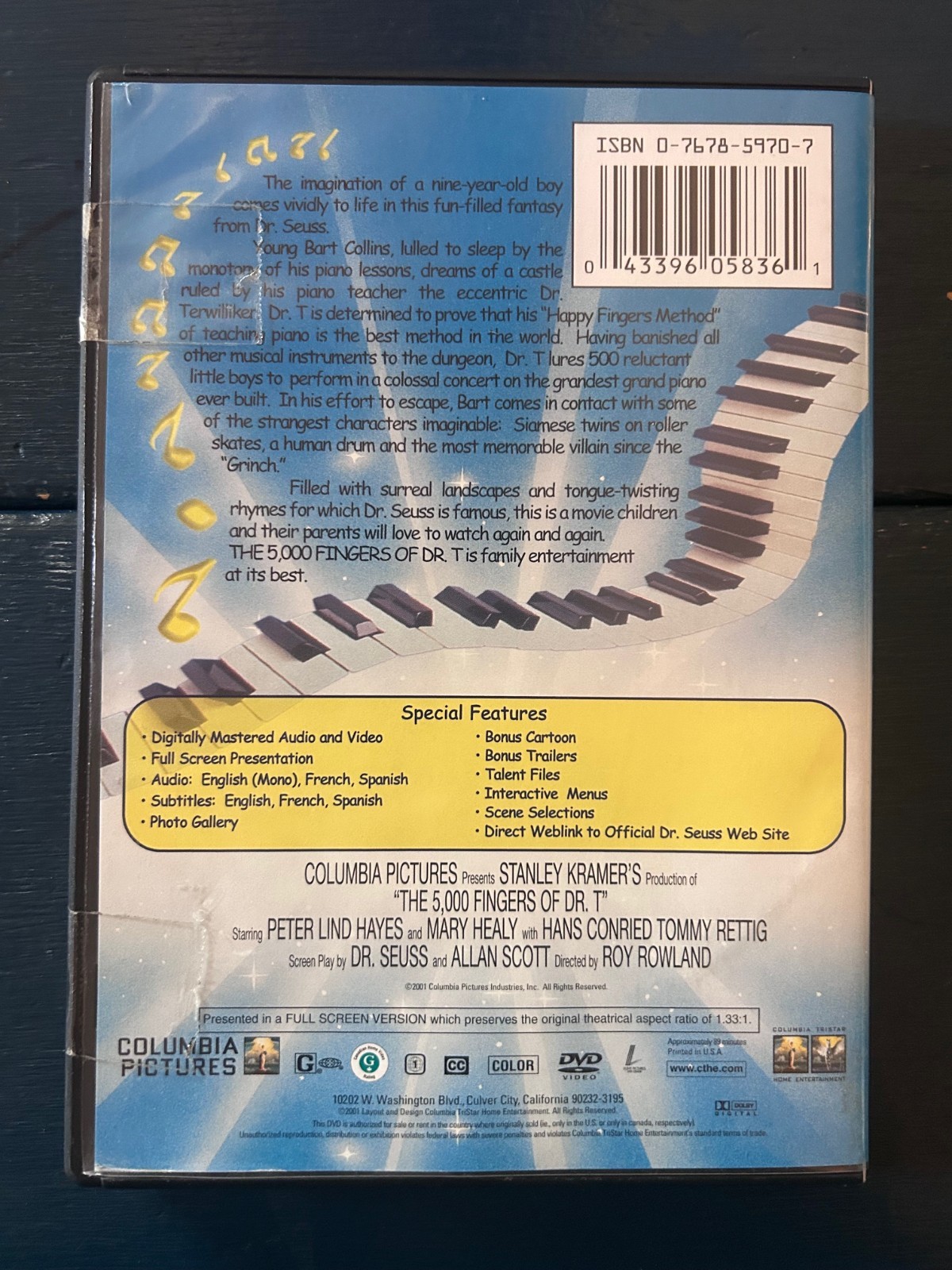
In 2001 the movie was released on DVD, including many special features. It re-released for Blu-ray in 2016.

The soundtrack on its own was finally released in 2007. In 2010 a special 3-disk-set released, collected and restored by singer Michael Feinstein, which included many of the cut songs and additional media he was able to recover from the production.

Themes / Lost Themes

Implied before, the movie is strongly anti-authoritarian and shows a world where everyone goes along with the fascist dictator - who believes the piano to be the purest instument and throws other musicians in the dungeon - until the kid comes along to start a revolution. My favorite and most sorely missed part of the script are the characters of the mother and the plumber (they have names). Both are complacent adults, each for their own reasons.

The mother Mrs. Collins obeys structure and order above anything else. Her cut song "Many Questions" is so good.

"Sure I know you want to ask me, why do children suffer such pain? Well when it comes to such things, it isn't easy to explain. It's no good to try, it's no good to lie, many questions have no answers, I just can't tell you why."


The plumber Zabladowski sees through the sham, but as a blue-collar worker can't afford to take risks that could cost him his job. "I get involved, I lose my job" is a mantra for him, established early when Mrs. Collins asks him to comment on Bart's dicipline. Later it's used to refuse to stand up against the evil Dr. T. Zabladowski has a full song dedicated to the line: "I Will Not Get Involved".

"This earth has 20-trillion kinds of problems to be solved. It's nothing new, so let it stew, I will not get involved. Let the old pot stew, let the old pot stew, I will not get involved."

"A plumber is a plumber! A plumber is NOT a children's aid society! A plumber is NOT a helping hand association! A plumber is NOT a publicbenefaction-assistance-movement, incorporated! & plumber is a plumber!"
2000 Glen Roven Stage Adaptation

First annnounced in 2000 but set to premiere in 2001, the musical went through many different writing and directing teams. They did not intend to use much of the original score and music, with new music provided by Glen Roven. The show was pushed back to 2002. The was then pushed back again to 2003, following the September 11 terrorist attack in downtown NYC. It was then delayed again, and again, with the last staged reading reportedly happening March 2004, until radio silence.

The book has gone through many different writers, first announced was Anthony Horowitz, then Karen Hartman in 2004, and recently Maria S. Schlatter is credited by Glen Roven on his website.

Songs for new adaptation were reportedly listed as "I Hate Music," "Happy Little Fingers," "No Balls Here," "You Deserve a Prince," Don't Mind If I Do," "Pickle Juice," "Small," "Crazy Music," "Lucky Me" and "If You Want to Rule the World." This may have been a licesning issue or a creative issue, but I at least strongly believe the original songs should have been used, with some arrangements and reprises added. I don't know if the film itself carries enough nostalgia for anyone to miss them, but there is something very strange about removing the movie from its 1950's time capsule.

I sill believe this show would work very well as a stage musical, even more so today, just maybe not in a Broadway setting. Taking cues from Seussical, which had an infamously rocky Broadway run but a very sucessful life in school and community theaters, I think this show should be thought of as one for a smaller company to produce. The anti-authoritarian and pro self-expression themes would ring just as true today. I would, however, base it off of the scrapped director's cut, and include as many of the original songs as possible. Through a mix of puppetry and shadow work, I don't think this show needs to be anywhere as big as they imagined it in order for it to succeed.

As I said, I think it's strange to remove from it's 50's time capsule. While just "current time" when it was made, 1950's setting today automatically calls on themes of the American nuclear family and strict assimilation. The same way it's used in movies like Edward Scissorhands or A Wrinkle in Time. The time period has the opportunity to add to the experience, not just in aesthetic but in the music as well, and I wouldn't want to remove that classic golden age 50's sound from the score to lull audiences into a sense of comfort and nostalgia.

Glen Roven died in 2018, so it is likley that this version of the soundtrack will never make it onstage.

2014 The Theatre on King

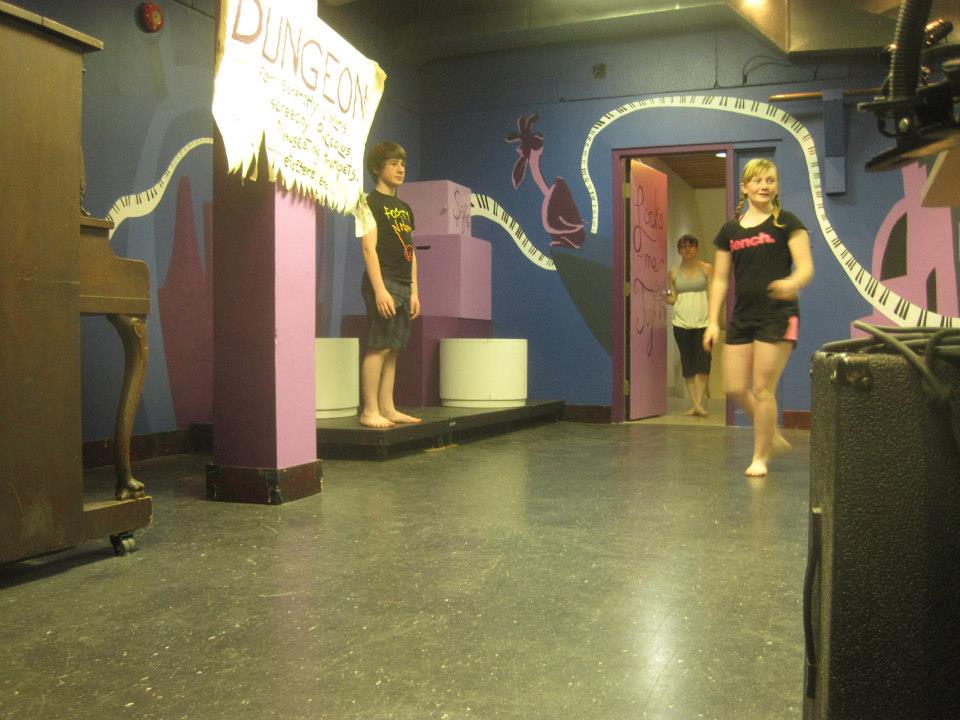
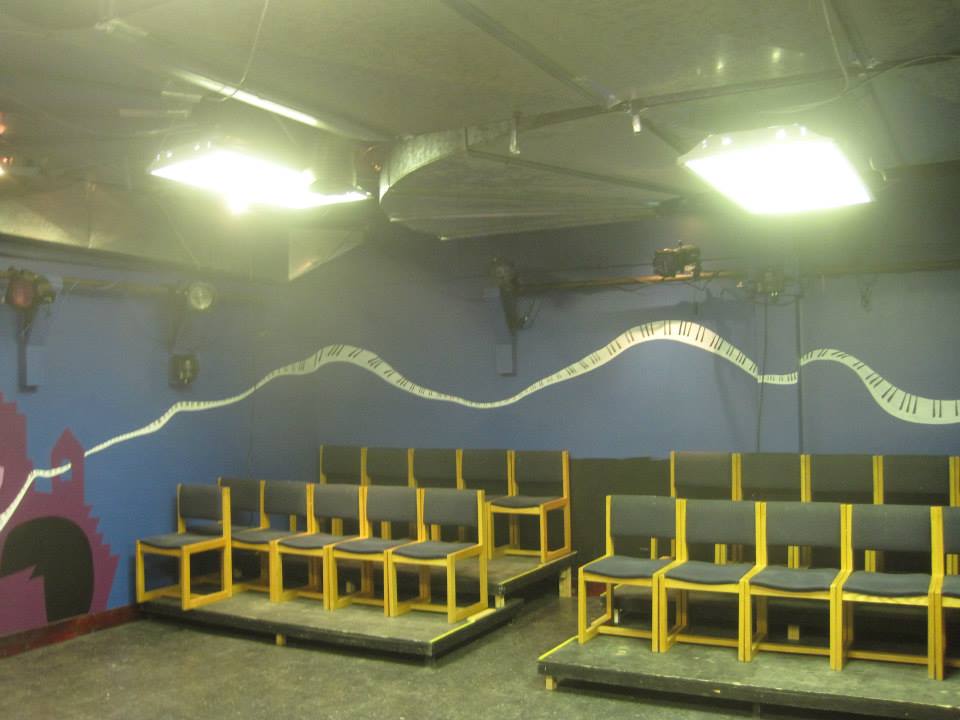
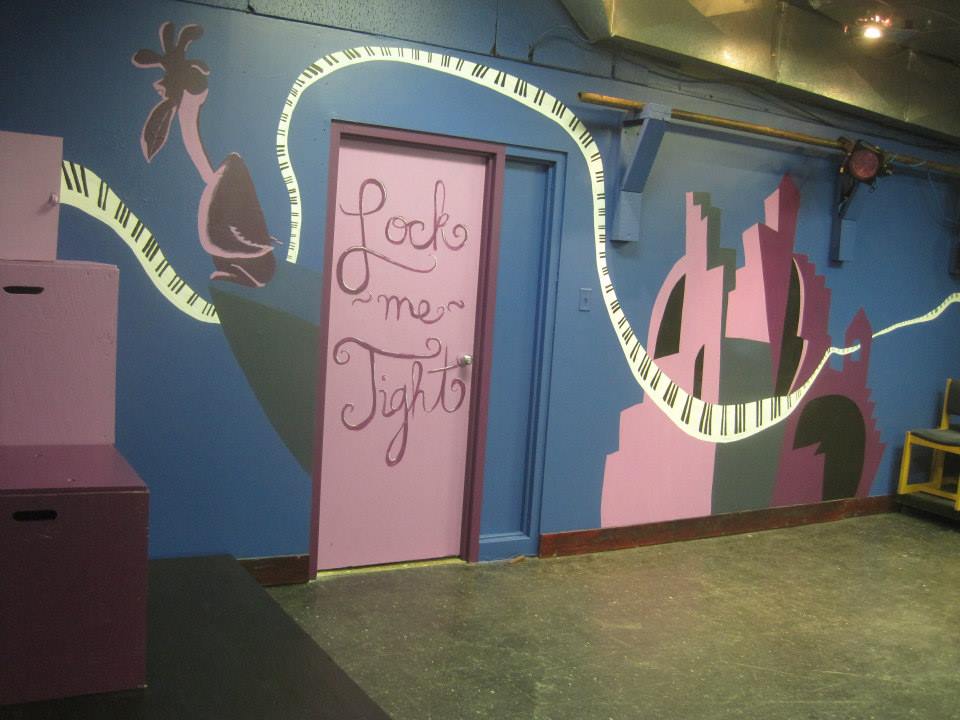
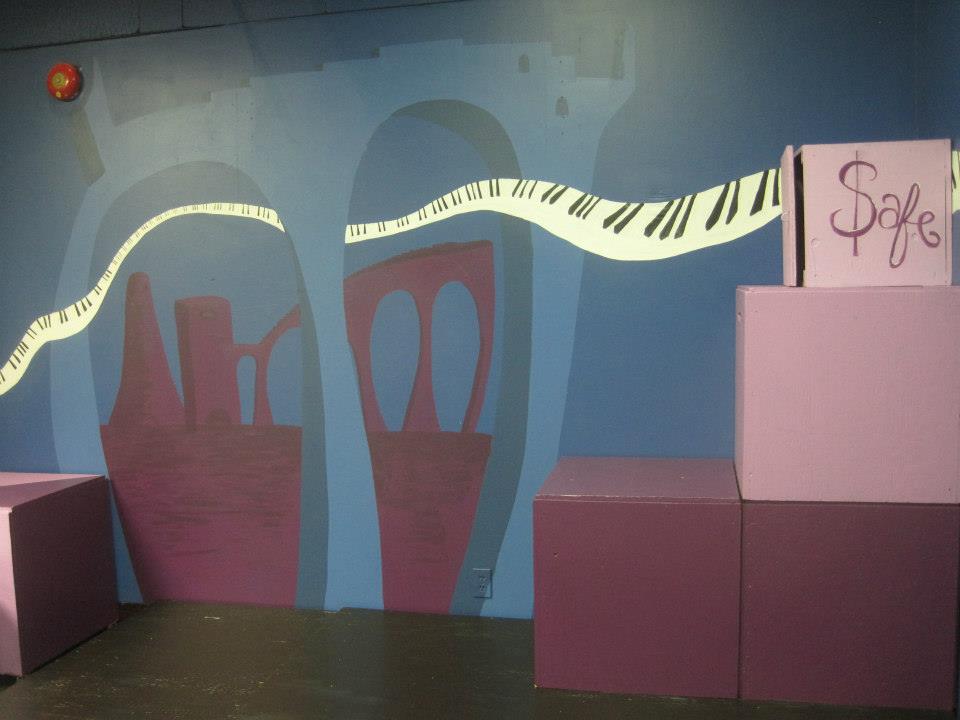
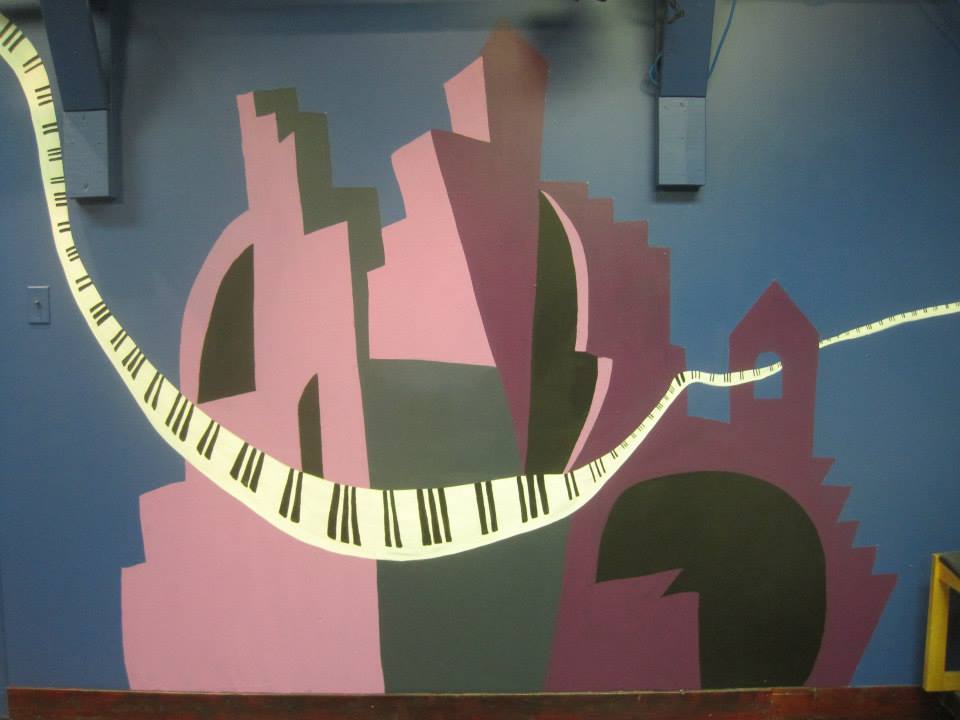
In 2014, a small community theatre company in Peterborough, Ontario produced a stage adaptation directly based onthe movie and its songs. This producion is likely unlicensed and without permission, all the better!

If you are about to think anything about how low-budget or unproffesional this production is:

Photo Gallery

Posters

David Fielding set designs for the scrapped Broadway run.

The Theatre on King