Babel
Jorge Luis Borges and the search for Minecraft's tallest cactus
A year or so ago, I became suddenly and entirely obsessed with the Library of Babel. A short story by Jorge Luis Borges about a theoretical library that contains every possible combination of letters.
More specifically, each book contains 22 letters and three characters, every page is unique, every book is unique. The Library is statistically finite, but observably infinite. There are more ways to shuffle a deck of cards than there are grains of sand on earth, and more pages in the Library than our human brains can comprehend. In the modern day, most creators focus on this description of a technology, and in the mordern day the concept of the Library is made simple through our own technology.
In fact, not only has someone made the Library of Babel, they have also made an Art Gallery of Babel which functions similarly with a finite set of pixels.
But in going back and re-reading Borges' story for myself, there is something more there than a theoretical math problem. Humanity's search for meaning in a chaotic universe. The denizens of the Library have known nothing but the Library. They are born and live and die within its walls. The Library existed long before their recorded history. The narrator compares his penmanship to the perfect printed letters of the Library's books, the messy lives and bodily needs of the human animals living within it to the cold unchanging world. And yet, the Library was built for people to live in it. There is food, and water, and bathrooms supplied. They are convinced it must be intelligent design.
What defines life in the Library is the Search. A library that contains all combinations of letters must contain the book wich describes the meaning of existence, if it's even in a language the reader can decipher. Whether that's in the Catalogue which holds the map to the Library's secrets, or the Crimson Room with its holy books, or the Man of the Book who can lead them to it, the denizens have created their own ways to hope for meaning in a sea of chaos.
Minecraft is a sandbox video game released in 2011. It uses a seed of numbers and letters to generate infinite (well, we don't have time to get into that) worlds, each fully unique. There are 281 trillion of these unique worlds. Statistically finite, observably infinite.
Of course, there are more structures guiding the world generation of a Minecraft world than the pure randomness of the Library. Stone at the bottom, dirt and grass on top, these biomes spawn with these trees and these ores are common at certain Y-levels.
The denizens of this world have similarly created Gods of pure chance. Gods that much exist, because they are theoretically possible within the boundaries of the game's code. There are a few of these sorts of videos:
- The search for the Minecraft world that beats itself
- The Quest for the Tallest Cactus in Minecraft
- Finding the Tallest Cactus in Minecraft
- The Minecraft seed you can beat by never moving
I'm not even the first one to make the connection between the open world sandbox game and Borges' story, Blucubed made a code that functions like a 3D-version of the Gallery of Babel. Borges' library held its secrets in one dimension, a string of text. The internet allowed us to create the Gallery, which allows for two dimensions in its pixels. But now you can walk through the 3D space of a small sculpture, generated in the limited block set of the game which is still many many times greater than Borges' 25 characters.
This video gets it.
The awe. The scale. The infinite. You are in the Library, walking from room to room, you see the infinite.
Where the online Library and Gallery fail to capture the true essence of the original story for me, is that they are built with a Catalogue acessible. We do not have to comprehend the horror of the seemingly infinite, mankind's search for meaning in the universe, or the futile arguments over religion, we are handed the answer. We can search for anything we want and come up with the seed to generate it. We are not the denizens, we are the Gods.
In the search for the tallest Minecraft cactus, there is no catalogue. There is no simply looking it up. There are still a number of ways the logical code behind world gen gives them clues, but they had to extract them from hours of triel and error and statistics. Flat deserts. Certain Y-levels. Things a computer can do the grunt work of, but even with our modern technology it has been an incredible feat taking hours of organization and planning from determined and capable humans.
They still have yet to find the actual theoretically possible tallest cactus. The God in the Library still evades us.
There's a reason this online literal Library project doesn't hold my attention for long, it's a novelty. The Library is the world we live in, the only world we have ever known, filled with a technology we are only starting to comprehend, the systems of the universe and our own existence. Infinitely improbable but born out of chance and time. Just like a Minecraft seed that can solve itself, we are the endermen and snow golemns that exist within the code of our own universe, puttering around until we land on something great. We don't get to hold the Catalogue. The best we can do is pick a really tall cactus to look for.
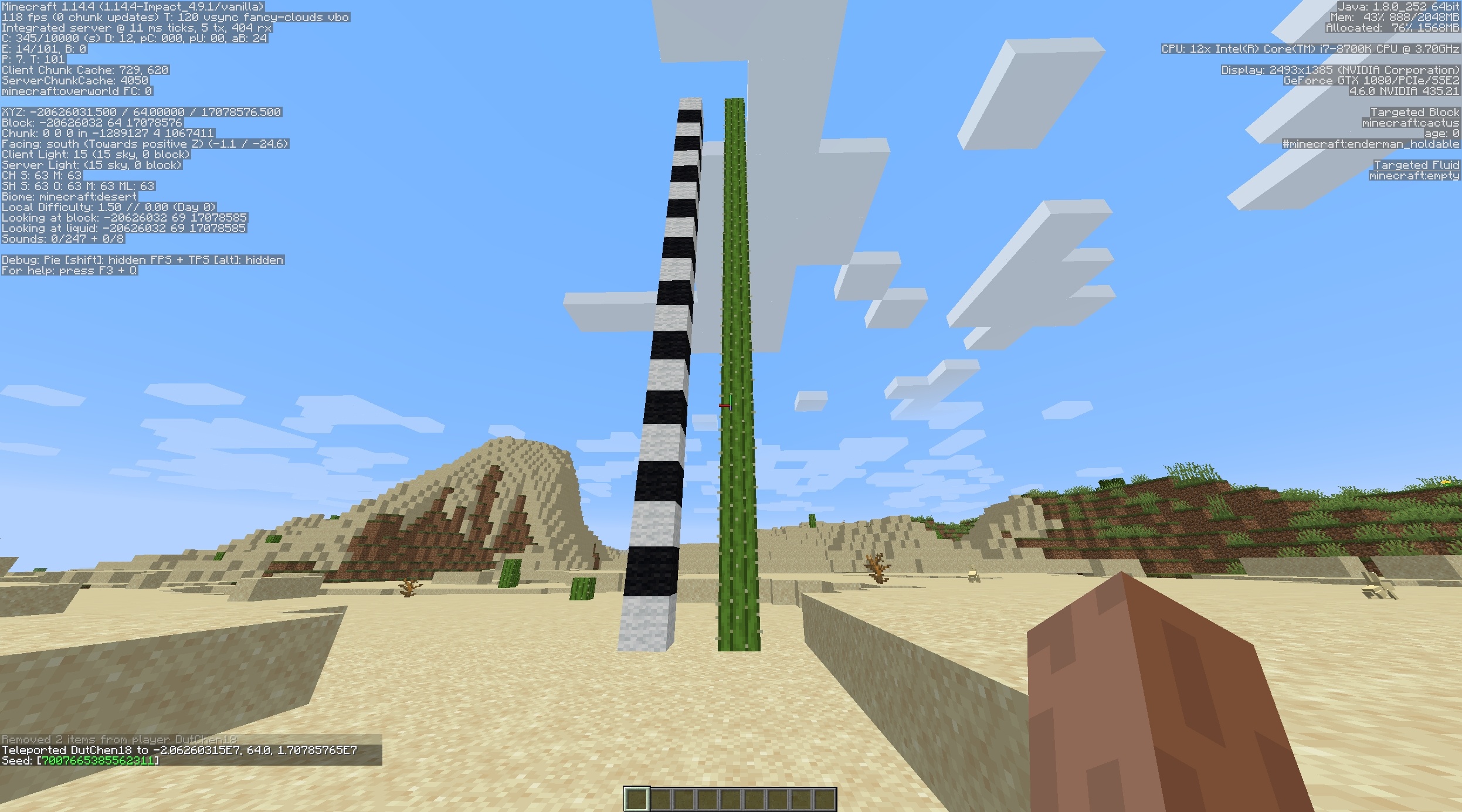
Wow, that is a tall cactus.