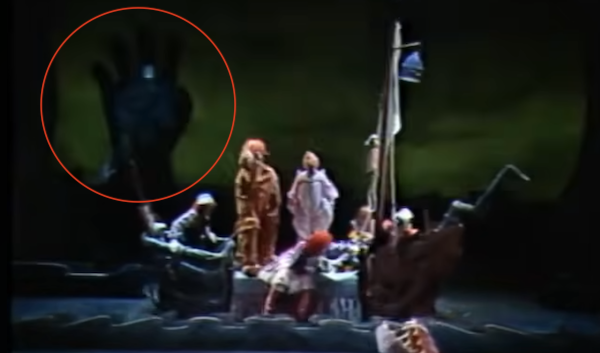
I recently watched Zach Barr (aka And Now They Sing)'s new video on The Pirates of Penzance, a slight re-make of their older video covering the 1980's production, now with extra commentary on the 2025 Pirates! A Panzance Musical. In both, but especially the newer one, their point is that it doesn't take a completely new script to reinvent the customs around the staging and design of any show. The 1980's Pirates made only minor book and music changes, the way they brought a fresh take on the piece was in the casting, vocal styling, and energetic physical performance, making Pirates the one Gilbert & Sullivan operetta to be considered a proper "musical" and performed by theaters that wouldn't think to do opera.
In the video, they also touch on what it means to democratize a show, to seperate it from a traditional sense of staging that is reinforced not by copyright law but by convention. They argue that the current (well, current starting in the 80's) push by producers to fund jaw-dropping megamusicals with something that you will only see on Broadway - be it effects or star-cast actors - starves regional and community theaters of contemporary shows that are acessible.
For example, take any of the Disney shows - Lion King or Aladin or Frozen - kids and families want to see these shows on Broadway because that's a recognizable character and story, and they're exited to see the special effects used to re-create the visuals in the movie. Of course, being popular movies and musicals, the producers are prepared to make a killing off the licensing rights. But what is Frozen without the Broadway visuals? Or Back to the Future? Or King Kong or Life of Pie or Death Becomes Her? These shows depend on budgets so big, once they move into licensing circles the theaters are left with two choices: struggle to re-produce the effects with a much lower budget, or pick a lesser-known work knowing that it will get less attention. That's why community theaters are still doing Grease and Footloose and the same classics, they are actually approachable from a company with a lower budget.
Now you might be saying, "Well those are IP musicals, they have to use stage tricks to match the animated visuals", and I say to you: "no they don't!!!" There are plenty of IP musicals that have reasonable scopes. You're a Good Man, Charlie Brown; Seussical; Addam's Family; and the most recent: Spongebob!
For those who haven't seen it, the Spongebob musical has really smart design! They approached the show with a lower budget (just like Seussical out-of-town) and made all the costumes and sets out of found-objects to give the sense of a bright and colorfull underwater city - possibly made from trash. Pool noodles, inflatable toys, sponges and mops and all sorts of junk make up the houses and plants. The costumes are clearly representative of the characters without trying too hard to match the literal animated designs - like official Disney-bounding!. Yes, the Broadway set is incredibly impressive and has a huge screen in the back, but despite all the money put into it, you can easily tell how it can be scaled down to a reasonable budget. You look at the set and think "I could do that". And even if no, your company's budget couldn't do that, you could do something really close!
I think of all this in regards to Rag Dolly, because the goal is to make a show that is approachable to license, not one that does well on Broadwway. These days, those are total opposites. Rag Dolly should be a show that inspires the company, director, and designer to think out of the box, to do what they can with a minimal budget, and give them the permission to do so. The conventions we create about how a show should be staged put enormous pressure on smaller companies to produce the show people expect - not just in text but in visuals and staging too - and deviating from that is very scary for a company with small margins. Shows like Spongebob and Seussical set a low barrier to entry, they are in conversation with low-budget productions instead of completely shutting them out to appeal to producers.
Like those shows, Rag Dolly is literally about imagination and wonder, as well as how impactful it can be to make a story out of nothing but rags, and that should inspire creative low-budget interpretations, not lock them out.
Additional note on Spongebob: it isn't perfect in this regard. There's a momment in the song BFF where Spongebob shows off "the incredible stretching sofa". It's a small gag in the Broadway, but this is a standout moment where the book demands a specific unique prop that is pretty tough to find/replicate, which ultimately could be replaced with any other similar silly gag. I've seen a couple school and community productions struggle with this bit! And it feels unecessary to require it in the licensed version. Stuff like this, going through with a fine-toothed comb, is what properly prepares a show for licensing.